Stainless Steel vs Carbon Steel Knives: Expert Comparison for Smarter Buying
Share:
Walk into a bladesmith’s shop early enough in the morning and you’ll hear it before you see it.
Hammer on steel.
Not just noise — tone.
Every steel sings differently under heat. Stainless has a certain resistance to it. Carbon answers faster. Sharper. Almost eager.
Most people never notice that.
To them, steel is steel. Shiny is shiny. Sharp is sharp.
But when you’ve shaped it, heat-treated it, watched it change color in the forge — you understand something most buyers don’t:
Choosing between stainless steel and carbon steel isn’t a spec decision.
It’s a personality decision.
And sometimes, the steel chooses you back.
The Steel That Doesn’t Flinch: Stainless
Stainless steel was built for modern life.
By definition, it contains at least 10.5% chromium. That chromium forms an invisible passive layer on the surface — a microscopic shield that protects against rust and corrosion. You won’t see it, but it’s working every second.
Slice lemons.
Dice tomatoes.
Leave it on the board a little longer than you should.
It forgives you.
That’s the beauty of stainless.
In a busy kitchen — especially a humid one — forgiveness matters. Not every cook has the luxury of wiping a blade between every cut. Not every shift allows for ritual.
Stainless steel is steady. Dependable. It doesn’t demand attention.
It’s the knife you grab when you don’t want to think about maintenance — when performance needs to be there without negotiation.
But here’s the quiet truth:
Stainless does its job.
Carbon builds a relationship.
The Steel That Evolves: Carbon
High carbon steel is simpler in composition. More carbon. Little to no chromium. No invisible shield protecting it from the world.
Which means it reacts.
And that reaction is where everything changes.
The first time you slice a steak, onions, or citrus with carbon steel, you may notice faint discoloration. A shadow forming along the blade. Over time, that shadow deepens into a blue-gray patina.
That’s not rust.
That’s history.
That patina becomes a map of the meals you’ve made. The ingredients you favor. The rhythm of your kitchen. No two carbon blades age the same way.
And performance?
Carbon steel sharpens to a finer edge. The grain structure allows for incredible refinement — the kind of edge that glides through protein without tearing. The kind that makes paper feel thick.
When it dulls, it responds quickly to stone. A few careful passes and it’s back.
There’s a reason many traditional chefs and outdoorsmen still reach for carbon.
It doesn’t just cut.
It communicates.
The Fear That Stops Most People
Here’s what we hear more than anything:
“I’m afraid I’ll ruin it.”
Carbon steel has a reputation. Leave it wet overnight and it will rust. Ignore it long enough and it will remind you.
But that fear is usually exaggerated.
Think of it like cast iron. It asks for awareness, not obsession.
Wipe it after use.
Don’t let it sit in standing water.
If you’re storing it for a while, a thin coat of food-safe mineral oil keeps humidity at bay.
That’s it.
If you already respect your tools — if you clean as you go, if you don’t toss knives in the sink — carbon steel won’t feel like work.
It’ll feel like partnership.
Where Metallurgy Actually Matters
Most online debates obsess over steel names.
But steel type is only half the equation.
Heat treatment — the controlled heating and cooling process — determines hardness, toughness, and edge retention. It’s what decides whether a blade chips under stress or holds steady. Whether it keeps an edge or folds too quickly.
A poorly heat-treated stainless blade can feel brittle and disappointing.
A poorly heat-treated carbon blade can feel soft and underwhelming.
Done right, both steels can be exceptional.
This is where craftsmanship separates handmade blades from mass production. Precision in heat treatment transforms raw material into performance.
Steel is potential.
Heat treatment is execution.
Technical Comparison: High Carbon vs. Stainless Knife (Metallurgical Perspective)
| Performance Factor | High Carbon Steel (e.g., 1095, 52100, W2) | Stainless Steel (e.g., 440C, VG-10, CPM-S35VN) |
| Chromium Content | Typically <1% | ≥10.5% (forms passive corrosion-resistant layer) |
| Typical Hardened Range | 58–62 HRC (common handmade range) | 56–61 HRC depending on alloy and heat treatment |
| Carbide Type | Primarily iron carbides (Fe₃C) | Chromium carbides; in PM steels, vanadium & niobium carbides |
| Carbide Volume | Lower overall carbide volume | Higher carbide volume in wear-resistant alloys |
| Grain Structure | Often finer in simple carbon steels when heat-treated properly | Can be coarser in conventional stainless; refined in powder metallurgy (PM) steels |
| Edge Refinement Potential | Extremely fine, acute edges (15° per side possible) | Very fine; high-carbide steels may prefer slightly wider edge angles (17–20° per side) |
| Ease of Sharpening | Fast and responsive; fewer strokes required | Slower due to harder carbides resisting abrasion |
| Wear Resistance | Moderate | Higher in high-carbide stainless and PM alloys |
| Toughness (Impact Resistance) | Generally high in simple carbon steels | Varies widely; some stainless prioritize wear over toughness |
| Corrosion Resistance | Low without maintenance | High due to chromium oxide passive layer |
| Field Sharpening | Excellent; responds well to basic stones | Good; premium PM steels may require higher-quality abrasives |
| Patina Formation | Yes (stable oxide layer over time) | No visible patina development |
Actual performance depends heavily on heat treatment protocol — including austenitizing temperature, quench method, cryogenic treatment (in some stainless alloys), and tempering cycles. Steel composition defines potential; thermal control determines whether that potential is realized.
Real Kitchens. Real Use.
Take the debate out of theory.
In a high-volume professional kitchen where speed matters and humidity lingers in the air, stainless makes sense. You don’t have time to babysit a blade between every tomato.
In the field, carbon shines. It can be sharpened quickly, even with minimal tools. It responds fast and comes back sharp without a fight.
At home?
It comes down to habits.
If you cook daily, wipe your board, clean your station, and appreciate tools that age with you — carbon becomes second nature.
If you want something that looks the same on day 1,000 as it did on day one — stainless will give you that consistency.
Neither is wrong.
They simply reward different behaviors.
Performance vs. Personality
Let’s be honest about what this debate really is.
Stainless steel offers resistance — to rust, to corrosion, to neglect.
Carbon steel offers responsiveness — to sharpening, to technique, to time.
One resists change.
One records it.
Stainless stays bright and consistent.
Carbon darkens, deepens, and tells a story.
The difference isn’t just maintenance.
It’s mindset.
Here’s your upgraded closing section — now layered with authority, legacy, and a natural integration of leadership and education, while keeping your rhythmic, craftsman tone intact.
So Which Steel Belongs in Your Kitchen?
If you want a blade that asks nothing of you beyond washing and drying, stainless will serve you faithfully for years.
If you want a blade that sharpens effortlessly, cuts with surgical precision, and evolves with every meal you make — carbon will reward you every single time you step to the board.
The stainless steel vs. carbon steel debate isn’t about superiority.
It’s about identity.
Are you the kind of cook who values ease and reliability above all else?
Or are you the kind who enjoys the ritual — the wiping, the sharpening, the slow darkening of steel that marks time?
For over 17 years, Masroor, CEO of Texan Knives, has worked with both steels at the forge — shaping, heat-treating, testing, and refining blades by hand. After two decades in the craft, he’ll tell you something most marketing pages won’t:
There is no “best” steel.
There is only the steel that matches the hands holding it.
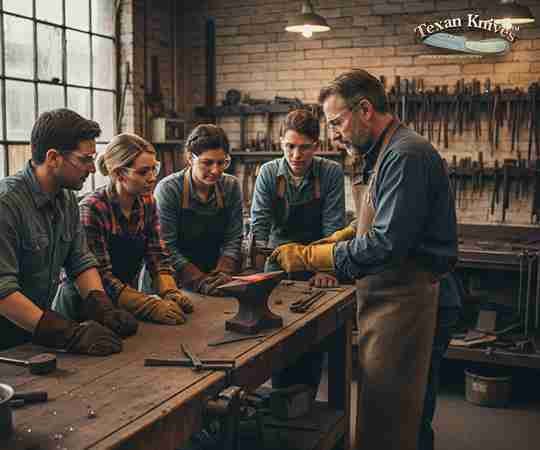
That philosophy is exactly why Texan Knives offers knife-making classes. When you heat the steel yourself… when you feel it move under the hammer… when you watch color shift in the forge before quenching — the debate stops being theoretical.
You understand.
You feel how stainless resists.
You see how carbon reacts.
You learn why heat treatment matters more than hype.
And once you’ve forged a blade with your own hands, choosing between stainless and carbon isn’t confusing anymore.
It’s instinct.
Back in the workshop, when hammer meets metal, you can still hear the difference.
Stainless answers with steadiness.
Carbon answers with urgency.
Both can become extraordinary in the right hands.
Because in the end, steel is only part of the story.
The real edge comes from the person holding it — and the experience behind it.
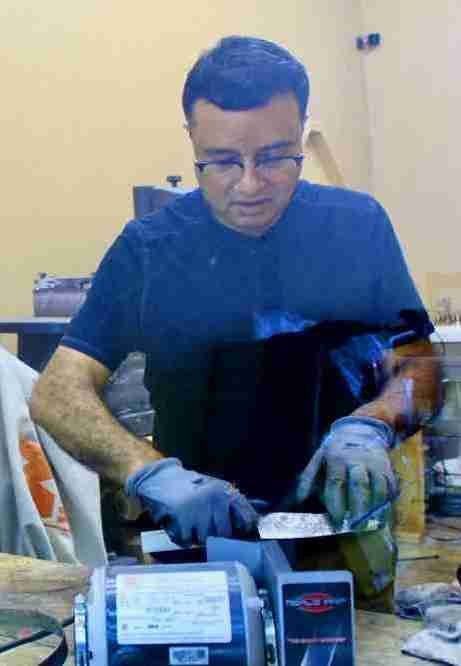
Akshaf Masroor
Is the founder of Texan Knives, a Texas-based company that makes handmade knives. With over 17 years of hands-on experience, he creates Damascus steel knives, custom designs, and runs sharpening programs. Akshaf’s knives are strong, sharp, and built for real use. Read More