Best Knife to Cut Turkey: Expert Guide to Safe & Perfect Carving

Share:
The High-Stakes Ritual of the Sunday Feast
Thanksgiving, a milestone family gathering, or a long Sunday feast in the heart of Texas comes with its own brand of pressure. You have invested days into this meal. You’ve brined the bird in a secret salt-and-spice solution, managed the airflow of a backyard smoker for twelve hours, and monitored the internal temperature with surgical precision. The skin is a deep, bronzed mahogany. The aroma of hickory and sage has drifted across the neighborhood.
Then comes the moment that defines the day: The Carve.
This is where many home cooks falter. They reach for a dull, “good enough” knife from a mass-produced block, and in seconds, the masterpiece is compromised. A poor blade doesn’t slice; it tears. It compresses the meat fibers, squeezing out the very moisture you spent eighteen hours preserving. At Texan Knives, we believe that the carve is not a chore—it is a ceremony. Guided by the 17-year forging experience of our master bladesmith, Masroor, we’ve developed this guide to ensure your tools and your technique honor the craft of Texas barbecue.
Part 1: Why Your Standard Chef Knife is Your Greatest Obstacle
Most kitchen enthusiasts rely on an 8-inch Western Chef knife for 90% of their tasks. While this is the “Swiss Army Knife” of the kitchen, it is fundamentally misaligned with the physics of a roasted turkey.
The Problem of Geometry
A standard Chef knife is designed with a “belly”—a pronounced curve from the heel to the tip. This design is optimized for a rocking motion on a flat cutting board, perfect for mincing parsley or dicing onions. However, when you apply this curve to a large, dense turkey breast, it creates “wedging.”
Because the blade is wide and curved, it creates significant surface friction as it passes through the meat. Instead of a clean, linear separation of fibers, the blade “drags,” resulting in:
- Torn Skin: The most flavorful part of the bird slides off the slice rather than staying attached.
- Ragged Edges: The “sawing” motion required by a short blade creates a jagged texture that feels dry on the tongue.
- Juice Loss: Every unnecessary “pump” of a dull knife acts like a sponge, forcing liquid out of the meat.
Part 2: The Metallurgy of a Masterpiece
To understand why a handcrafted knife performs differently, we must look at what happens inside the forge. Masroor’s philosophy is that a blade should “communicate” with the cook. This communication is made possible by three metallurgical pillars:
- The Distal Taper
In factory-stamped knives, the thickness of the steel is consistent from the handle to the tip. In a Texan Knives hand-forged slicer, we utilize a “distal taper.” This means the spine of the knife gradually thins as it reaches the point.
- Why it matters: A tapered tip is flexible and sensitive. It allows you to “feel” your way around the hip joint or the wing socket without having to hack through bone. It gives the knife a sense of balance that makes a 12-inch blade feel as nimble as a paring knife.
- Grain Refinement and Edge Retention
When Masroor hammers high-carbon steel under intense heat, he is refining the molecular grain of the metal. A finer grain allows for a “keener” edge—one that is sharpened to a microscopic point. Factory knives often use softer steel to avoid breaking during mass production, but this means they “roll” their edge after just a few slices. A hand-forged blade holds its “bite,” ensuring the 50th slice is as clean as the first.
- Carbide Volume and Friction
By controlling the cooling process (quenching), we manage the carbide distribution in the steel. A higher-quality steel with a specialized heat treatment reduces the friction coefficient. Essentially, the blade becomes “slippery” in the meat, gliding through the protein without sticking.
Part 3: Choosing Your Steel – Carbon vs. Stainless
At the Texan Knives workshop, we often see a divide between the “Ritualist” and the “Realist.”
The High-Carbon Steel Slicer (The Ritualist)
High-carbon steel is the traditional choice for pitmasters. It is capable of achieving an almost frightening level of sharpness.
- The Patina: Over time, carbon steel reacts with the proteins and acids in your food, developing a blue-gray “patina.” This isn’t rust; it’s a protective layer that tells the story of every feast you’ve prepared.
- Maintenance: It requires a “wipe-as-you-go” mentality. You cannot leave it in a sink. For many, this ritual of cleaning and oiling the blade is a therapeutic end to the meal.
The High-End Stainless Slicer (The Realist)
Modern metallurgy has closed the gap. Using premium alloys like VG-10 or CPM-S35VN, we can create stainless blades that rival carbon steel for sharpness while offering total rust resistance.
- Best for: Humid environments (like a Texas summer) or cooks who want elite performance without the maintenance requirements of carbon steel.
Part 4: The 10-Step Professional Carving Protocol
Even the world’s finest blade cannot save a poor technique. Follow this protocol, refined in our knife-making classes, to ensure professional results.
- The Critical Rest (45 Minutes)
If you cut a turkey as soon as it leaves the smoker, the internal pressure will force the juices out like a punctured balloon. Let the bird rest for at least 30 to 45 minutes. The internal temperature will carry over, and the muscle fibers will relax, “locking in” the moisture.
- The Honing Ritual
Before the first cut, use a ceramic or steel honing rod. This does not remove metal (like sharpening); it realigns the microscopic “teeth” of the edge that may have folded during storage.
- Secure the Board
A sliding cutting board is a safety hazard. Place a damp paper towel under your board to lock it in place. You need a stable platform for confident strokes.
- Remove the Legs and Wings
Slice through the skin between the leg and the breast. Pull the leg outward to expose the joint. A sharp tip will allow you to pop the ball out of the socket cleanly. Repeat for the wings.
- The “Texas Side-Saddle” Breast Removal
Instead of slicing thin strips off the bird while it’s on the bone, follow the breastbone with your knife and remove the entire breast in one large piece. This gives you a flat, stable “log” of meat on your board.
- The Long Glide
Position your 12-inch slicer at the thick end of the breast. Using the full length of the blade, pull the knife toward you in one smooth, continuous motion. Avoid the “back-and-forth” sawing.
- Maintaining Skin Integrity
Angle your knife slightly so that you are cutting through the skin first, then the meat. This “perforates” the skin and prevents it from tearing away from the slice.
- The Dark Meat Breakdown
Separate the drumstick from the thigh. Slice the thigh meat parallel to the bone. Dark meat is more forgiving but benefits from the same clean, long-stroke approach.
- The Platter Presentation
Arrange the slices in an overlapping fan pattern. Drizzle a small amount of warm stock or “au jus” over the meat just before serving to add a professional glisten.
- Cleaning and Storage
Immediately hand-wash your knife with warm soapy water. Dry it with a clean towel—never let it air dry. If using carbon steel, apply a drop of food-safe mineral oil to the blade.
Part 5: The Psychology of Confidence
There is a tangible difference in the atmosphere of a kitchen when the carver is confident. When you use a tool that is perfectly balanced—a tool that feels like an extension of your arm—your movements become graceful. This confidence is felt by your guests. It turns a “task” into a “performance.”
Masroor’s goal at Texan Knives is to provide that confidence. When you hold a blade that has been hammered, quenched, and ground by a master, you are holding 17 years of trial and error. You are holding a piece of Texas history.
Conclusion: Honor the Bird
In the end, choosing the right knife is an act of respect. It respects the animal, it respects the hours of labor you spent at the grill, and it respects the guests you are serving. A ragged, dry slice of turkey is a missed opportunity. A clean, moist, perfectly fanned slice is a triumph.
Next time you stand before the bird, ask yourself: Are you sawing, or are you slicing?
Ready to Upgrade Your Kitchen Arsenal?
Don’t wait until the next holiday to discover the difference that handmade steel makes. Whether you are looking for a High-Carbon Slicer or interested in joining one of our Knife-Making Workshops to forge your own legacy, Texan Knives is here to elevate your craft.
FAQs
1. What is the best knife for carving a turkey?
A long, narrow slicing knife works best for carving turkey because it creates clean, smooth cuts through the meat. While a Chef’s knife can work, a dedicated carving or slicing knife usually produces better results.
2. How long should a turkey rest before carving?
A turkey should rest for about 30 to 45 minutes after cooking. Resting allows the juices to redistribute inside the meat, making the slices more moist and flavorful.
3. Why does turkey meat tear when carving?
Turkey meat often tears when the knife is dull or when short sawing motions are used. Using a sharp knife and long, smooth strokes helps maintain clean slices and keeps the skin attached to the meat.
4. Should you slice turkey on the bone or remove the breast first?
Many professionals remove the whole breast from the bone first. This allows you to place it flat on the cutting board and slice it evenly and more precisely.
5. Is carbon steel better than stainless steel for carving knives?
Both can work well. Carbon steel knives can achieve extremely sharp edges, while high-quality stainless steels like VG-10 steel offer strong edge retention with better rust resistance.
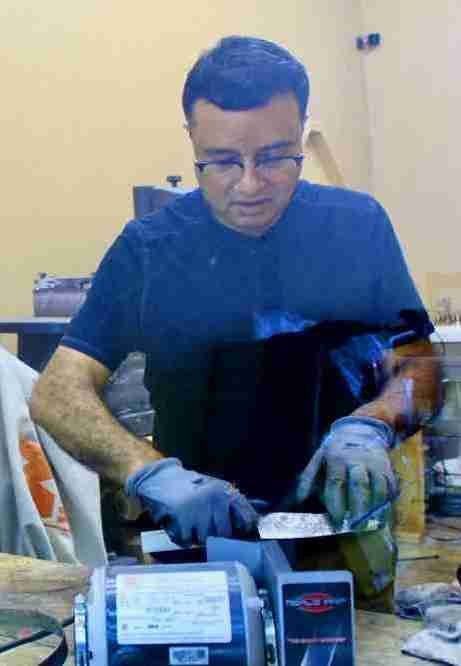
Akshaf Masroor
Is the founder of Texan Knives, a Texas-based company that makes handmade knives. With over 17 years of hands-on experience, he creates Damascus steel knives, custom designs, and runs sharpening programs. Akshaf’s knives are strong, sharp, and built for real use. Read More